Is the Multi-Agent System Another Hallucination?
A Review of Failure Diagnosis in LLM Agents and Multi-Agent Systems
Background and Scope
The concept of an intelligent agent predates large language models (LLMs). Wooldridge and Jennings (1995) describe agents through properties such as autonomy, social ability, reactivity, and pro-activeness, while later multi-agent systems (MAS) research treats interacting agents as autonomous computational entities that can coordinate toward individual or collective goals (Wooldridge, 2009). From a software-engineering perspective, Zambonelli et al. (2003) further characterize a MAS as a computational organization whose roles, relationships, and interaction structures can be explicitly designed.
LLM-based agents extend these earlier ideas with natural-language reasoning, tool use, memory, and orchestration. This extension also broadens the failure surface: a problem may originate in code or configuration before deployment, emerge at a particular runtime step, propagate across a long trajectory, or arise from coordination and verification problems among multiple agents. The literature reviewed below therefore forms a progression from pre-deployment security analysis to trajectory-level root-cause diagnosis and system-level MAS failure analysis.
Pre-Deployment Security: Agent Audit
Agent Audit focuses on security failures in the software stack surrounding an LLM agent rather than on model behavior alone. It analyzes Python agent code and deployment artifacts for risks such as untrusted data reaching dangerous operations, exposed credentials, unsafe prompt construction, and over-privileged Model Context Protocol (MCP) configurations (Zhang et al., 2026). Its agent-aware analysis combines tool-boundary detection, intra-procedural taint tracking, credential detection, structured configuration parsing, and privilege checks. The accompanying Agent-Vuln-Bench contains 42 annotated vulnerabilities across 22 samples; Agent Audit reports 40 of them, with six false positives (Zhang et al., 2026).
The method is useful as a pre-deployment guardrail, but its scope also defines an important boundary. The current implementation does not track inter-procedural data flow, primarily targets Python, and does not execute or simulate runtime prompt-injection payloads (Zhang et al., 2026). In other words, static analysis can identify a risky tool boundary or sink, but it cannot by itself establish whether a particular runtime interaction actually caused a failed trajectory. This limitation motivates execution-trace approaches that reason over what happened during an agent run.
Evidence-Grounded Trajectory Diagnosis: AgentRx
Barke et al. (2026) address runtime failure localization in settings where executions are probabilistic, long-horizon, multi-agent, and affected by noisy tool outputs. Their benchmark contains 170 failed trajectories across 11 task settings, each annotated with a critical failure step and a root-cause category. AgentRx normalizes heterogeneous logs into a common trajectory representation, synthesizes verifiable constraints from tool schemas, domain policies, task requirements, and the observed trajectory, and checks those constraints step by step. The resulting validation log records violated obligations and supporting evidence, which an LLM-based judge then uses to identify the critical failure step and category (Barke et al., 2026).
Figure 1
Constraint-based failure localization in AgentRx
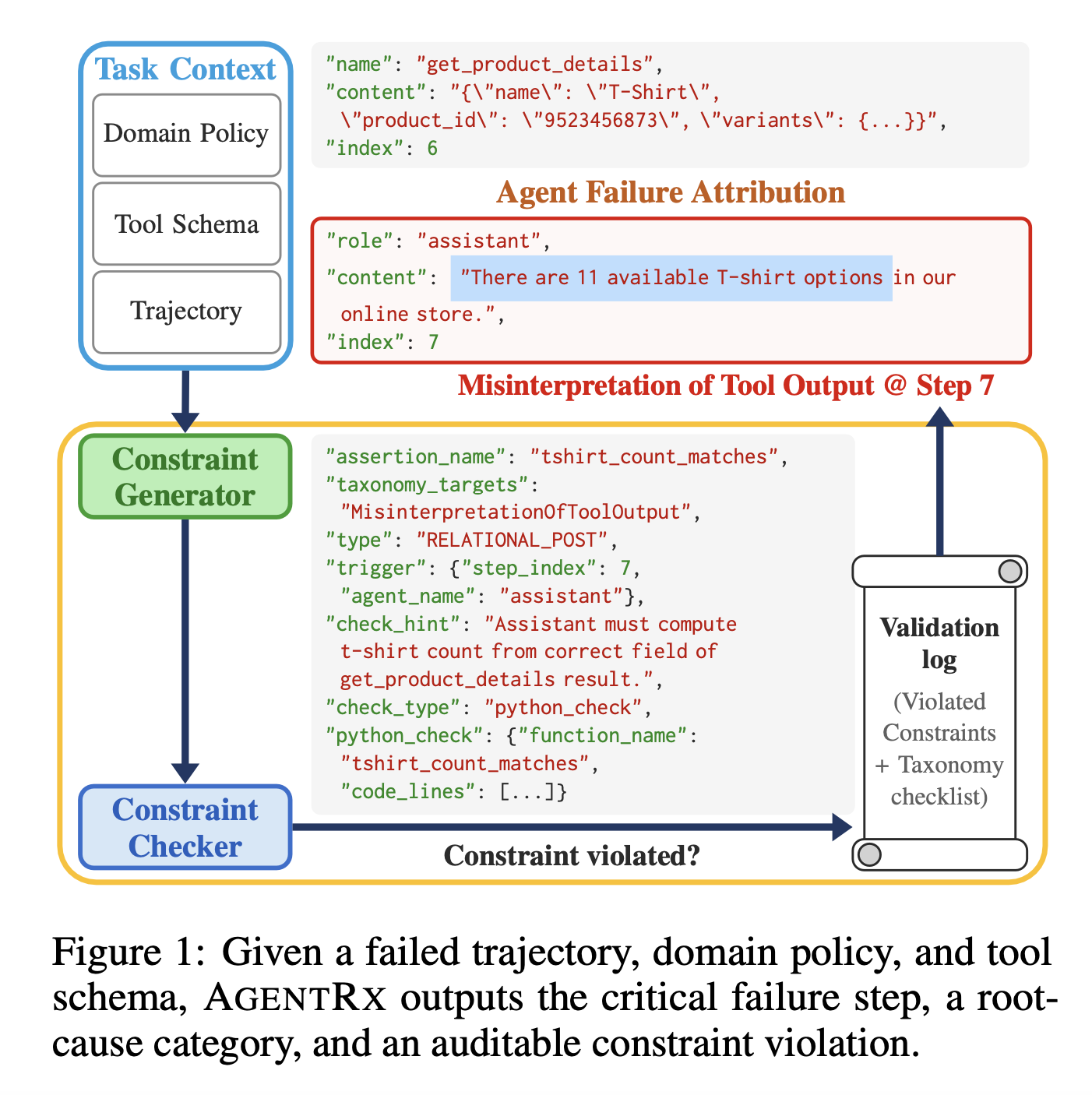
Note. Reproduced from “AgentRx: Diagnosing AI Agent Failures from Execution Trajectories,” by S. Barke, A. Goyal, A. Khare, A. Singh, S. Nath, and C. Bansal, 2026, Findings of the Association for Computational Linguistics: EMNLP 2026, p. 12610 (https://aclanthology.org/2026.findings-emnlp.598/). Copyright 2026 by the Association for Computational Linguistics.
A key design choice is the definition of a critical failure as the first unrecoverable failure introduced by any agent in the trajectory (Barke et al., 2026). This creates a clear and economical annotation target and makes the final diagnosis auditable because the selected step is supported by an explicit violation record. The benchmark annotations also illustrate how a root cause is separated from other observed failures.
Figure 2
Example of an AgentRx root-cause annotation for an instruction-adherence failure
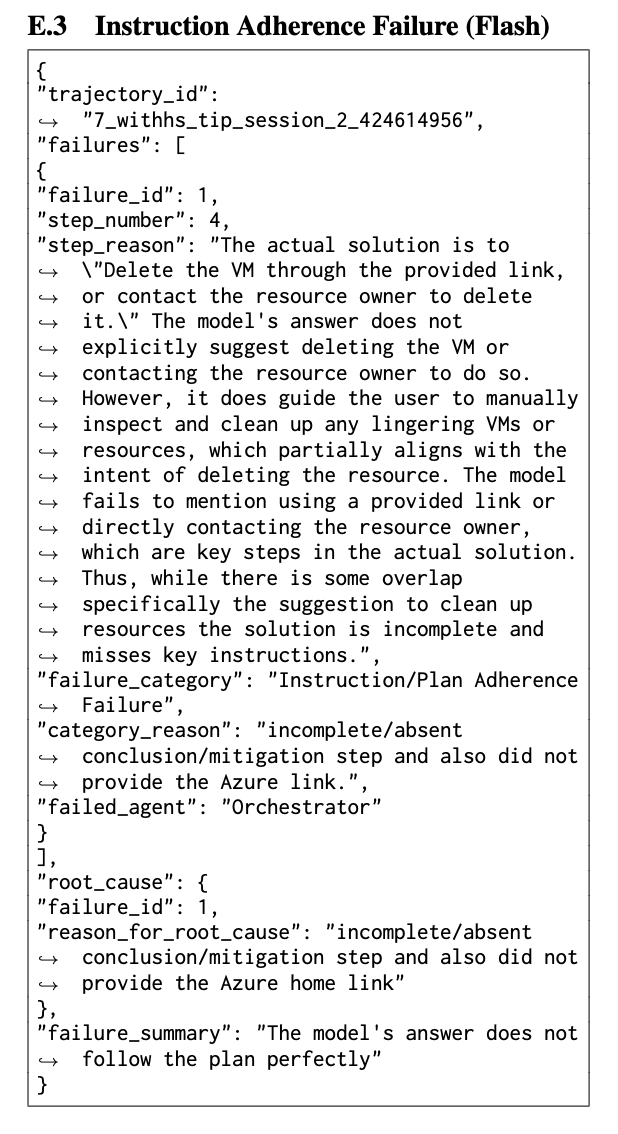
Note. Reproduced from Appendix E.3 of “AgentRx: Diagnosing AI Agent Failures from Execution Trajectories,” by S. Barke et al., 2026, Findings of the Association for Computational Linguistics: EMNLP 2026, p. 12627 (https://aclanthology.org/2026.findings-emnlp.598/). Copyright 2026 by the Association for Computational Linguistics.
The single-critical-step formulation, however, leaves a broader attribution question open. Earlier actions may be recoverable in isolation yet still increase the likelihood or severity of a later failure, and similar problematic actions may recur across several agents. A richer model could therefore distinguish the decisive failure from contributory steps and assign different degrees of responsibility across the trajectory. This is especially relevant when the same behavior appears across agents or when similar tasks fail through different pathways.
Cascading Errors and Recovery: AgentErrorTaxonomy, AgentErrorBench, and AgentDebug
Zhu et al. (2025) shift the focus from a single observed failure to error propagation. Their central premise is that an early mistake can alter later reasoning and actions, producing a cascade of downstream errors that are symptoms rather than independent root causes. They introduce AgentErrorTaxonomy to classify failures across memory, reflection, planning, action, and system-level operations, and AgentErrorBench to evaluate whether a model can identify critical errors and produce actionable corrective feedback from real agent rollouts (Zhu et al., 2025).
Figure 3
Construction pipeline for AgentErrorTaxonomy and AgentErrorBench
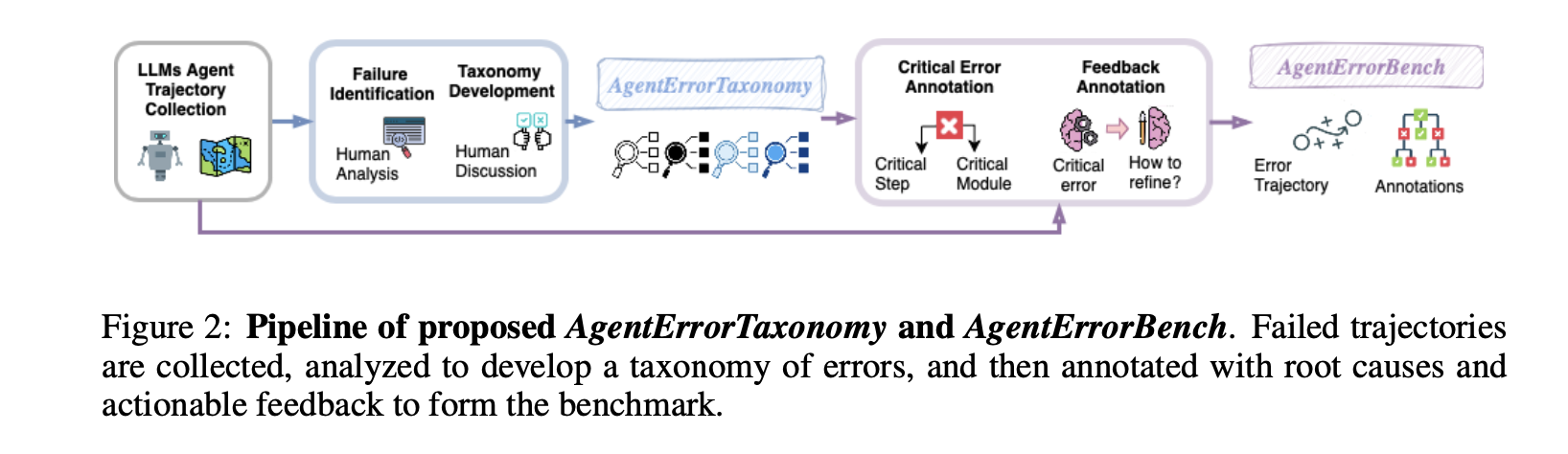
Note. Reproduced from “Where LLM Agents Fail and How They Can Learn From Failures,” by K. Zhu et al., 2025, Figure 2, arXiv (https://doi.org/10.48550/arXiv.2509.25370).
AgentDebug operationalizes this idea through modular, step-level analysis. For each decision step, the framework examines memory, reflection, planning, and action behavior and maps detected problems to the taxonomy. It then considers the complete trajectory, the modular error profile, the taxonomy, and a critical-error criterion to identify a minimal set of critical errors and generate corrective feedback. The earliest critical root-cause step is used as the restart point. Instead of rerunning the task from the beginning, the agent is re-executed from that point with targeted feedback; if the new rollout still fails, the feedback is refined and the process repeats (Zhu et al., 2025).
This approach directly complements AgentRx. AgentRx emphasizes auditable evidence for the first unrecoverable failure, whereas AgentDebug explicitly reasons about dependencies between early root causes and downstream symptoms and connects diagnosis to recovery. Even so, selecting an earliest restart point still compresses a potentially distributed causal process into a small set of root causes. In multi-agent settings, the remaining question is not only which step was earliest, but how responsibility should be distributed when several agents, states, or repeated actions jointly contribute to failure.
System-Level Multi-Agent Failure Patterns: MAST
Cemri et al. (2025) broaden the unit of analysis from individual trajectory steps to recurrent failure patterns across multi-agent systems. They define a failure as a case in which the MAS does not achieve its intended task objective and introduce MAST-Data, comprising 1,642 annotated traces from seven MAS frameworks. The Multi-Agent System Failure Taxonomy (MAST) identifies 14 failure modes grouped into three categories: system design issues, inter-agent misalignment, and task verification (Cemri et al., 2025).
MAST is derived using Grounded Theory rather than imposed a priori. The authors use open coding to identify observed failure behavior, constant comparison to refine categories across systems, memoing to preserve analytical insights, and iterative theorizing until additional analysis yields no substantively new failure modes (Cemri et al., 2025; Glaser & Strauss, 1967). Expert annotation achieved high agreement, and an LLM-as-a-Judge pipeline was subsequently calibrated for scalable labeling. This use of LLM-based evaluation is practical, although judge-based pipelines should still be interpreted cautiously because LLM evaluators can exhibit position, verbosity, self-enhancement, and reasoning biases (Zheng et al., 2023).
Figure 4
MAST taxonomy of multi-agent system failure modes across conversation stages
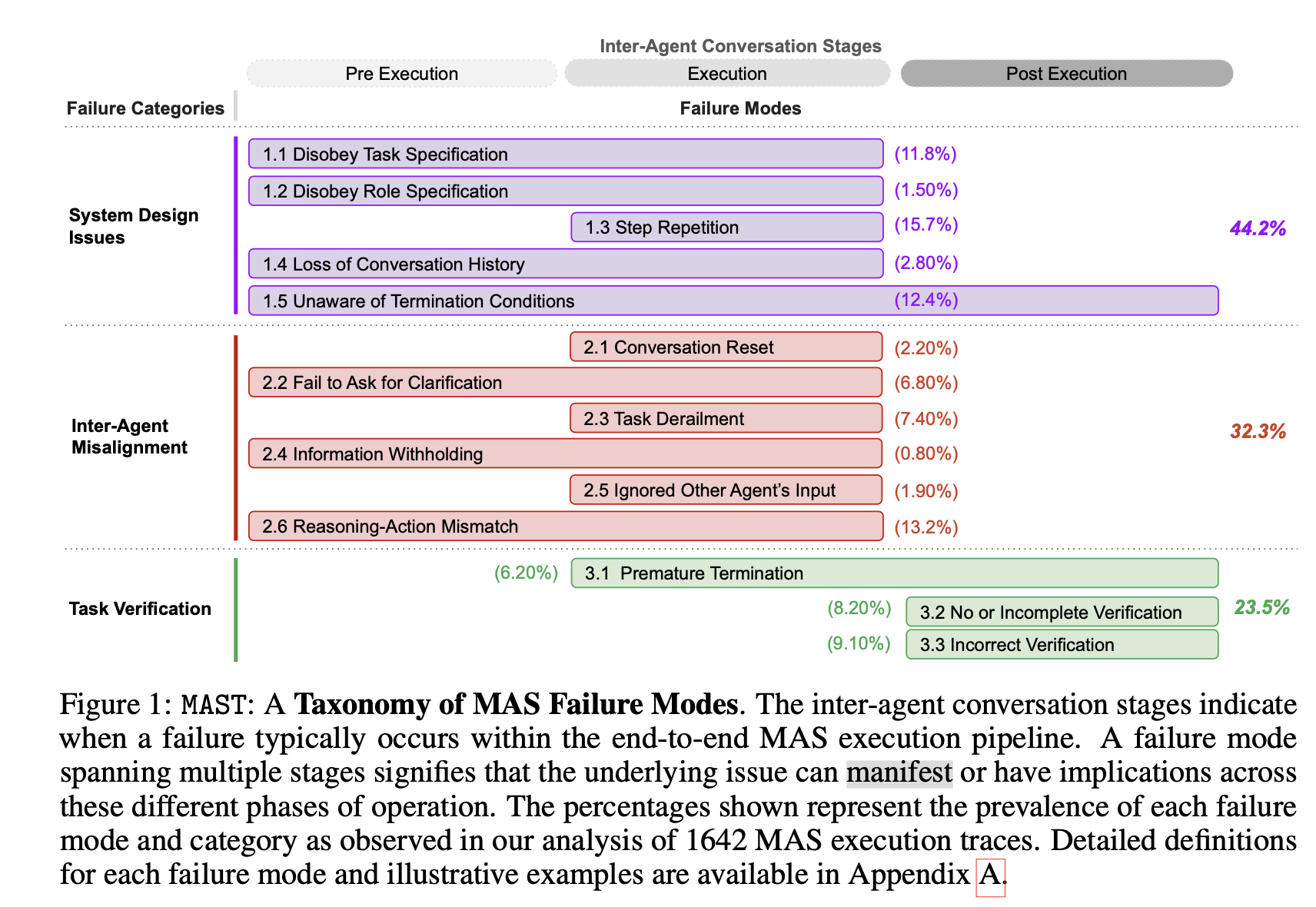
Note. Reproduced from “Why Do Multi-Agent LLM Systems Fail?” by M. Cemri et al., 2025, Figure 1, Advances in Neural Information Processing Systems, 38 (https://doi.org/10.52202/085713-4082).
MAST therefore complements trajectory-localization work by exposing structural and interaction-level failure modes that may span pre-execution, execution, and post-execution stages. However, taxonomy membership does not by itself establish which agent or step causally contributed most to a failure. MAST is strongest at describing recurring system-level patterns, while AgentRx and AgentDebug are stronger at localizing failure within a particular execution. The unresolved problem lies in connecting these levels of analysis.
Table 1
Connections Across the Reviewed Failure-Analysis Approaches
| Study | Primary unit | Stage | Core mechanism | Main output | Key limitation |
|---|---|---|---|---|---|
| Agent Audit (Zhang et al., 2026) | Code/configuration | Pre-deployment | Static, taint, and configuration analysis | Security findings and risky boundaries | Cannot establish runtime causal paths |
| AgentRx (Barke et al., 2026) | Trajectory step | Post-failure | Constraint synthesis, validation evidence, LLM judge | First unrecoverable step and category | Focuses attribution on one decisive step |
| AgentDebug (Zhu et al., 2025) | Step/module | Diagnosis + recovery | Modular error analysis, root-cause detection, reroll | Critical errors, feedback, recovery | Distributed responsibility remains compressed |
| MAST (Cemri et al., 2025) | MAS-level pattern | Across stages | Grounded-theory taxonomy + LLM annotation | 14 design, alignment, and verification modes | Labels do not directly prove causal contribution |
Note. The table summarizes the conceptual connection across the reviewed studies; the “key limitation” column is a synthesis of their scopes rather than a claim made verbatim by each paper.
Cross-Study Inferences
-
Failure evaluation is moving from endpoint success/failure toward process-level diagnosis based on trajectories, intermediate actions, and observable evidence.
-
The reviewed methods operate at different granularities—code/configuration, step, functional module, and system-level interaction—yet no shared representation currently unifies these levels.
-
Using the first or earliest critical failure is efficient for localization and reroll, but it may underrepresent cumulative or distributed responsibility when multiple earlier steps contribute to the final outcome.
-
Evidence of a rule violation and evidence of causal responsibility are related but not identical: a violated constraint can show what was wrong without proving how much that step contributed to the terminal failure.
-
Cross-agent and cross-trajectory recurrence is underused. Repeated failure signatures across agents or similar tasks could help distinguish one-off mistakes from systematic design weaknesses.
-
A robust debugging pipeline likely needs both prevention and runtime diagnosis: static security analysis can identify risky boundaries, while trajectory analysis is required to verify manifestation, propagation, and recovery.
Remaining Gap and Research Directions
Taken together, the literature has made substantial progress in defining failure modes, localizing critical steps, grounding diagnoses in explicit evidence, and using root-cause feedback for recovery. The main unresolved gap is a unified causal attribution framework that can connect pre-deployment risk, runtime evidence, multi-step error propagation, and multi-agent interaction while preserving auditable explanations. In particular, existing methods do not yet provide a general mechanism for assigning graded responsibility across several contributory steps or agents, nor do they systematically compare related trajectories to determine whether the same underlying behavior produces different failure paths.
A promising direction is responsibility-weighted causal attribution: instead of returning only one critical step, a debugger could estimate the relative contribution of several steps and agents, then validate those estimates through controlled reruns or counterfactual interventions. Recent work is already moving toward this direction. TrajDebug tracks the lifecycle, resolution status, and terminal impact of multiple local errors rather than treating every detected error as equally causal (Qi et al., 2026). Pothuru (2026) goes further by using injected faults and downstream re-execution to evaluate causal failure localization against a known intervention site. These approaches suggest that future MAS debugging could combine constraint-based evidence, error-lifecycle tracking, cross-agent causal graphs, and cross-trajectory comparison. Such a framework would move failure analysis from “where did the system first become unrecoverable?” toward the broader question of “which actions and agents contributed to failure, by how much, and which intervention would most reliably prevent recurrence?”
References
Barke, S., Goyal, A., Khare, A., Singh, A., Nath, S., & Bansal, C. (2026). AgentRx: Diagnosing AI agent failures from execution trajectories. Findings of the Association for Computational Linguistics: EMNLP 2026, 12610–12639. https://aclanthology.org/2026.findings-emnlp.598/
Cemri, M., Pan, M. Z., Yang, S., Agrawal, L. A., Chopra, B., Tiwari, R., Keutzer, K., Parameswaran, A., Klein, D., Ramchandran, K., Zaharia, M., Gonzalez, J. E., & Stoica, I. (2025). Why do multi-agent LLM systems fail? Advances in Neural Information Processing Systems, 38. https://doi.org/10.52202/085713-4082
Glaser, B. G., & Strauss, A. L. (1967). The discovery of grounded theory: Strategies for qualitative research. Aldine Publishing Company.
Pothuru, L. (2026). When failures propagate: Causal failure attribution in agentic retrieval-augmented generation. In Proceedings of the Second Workshop for REsearch on Agent Language Models (REALM 2026) (pp. 675–686). Association for Computational Linguistics. https://aclanthology.org/2026.realm-1.46/
Qi, Y., Yin, Z., Shi, X., Peng, H., Lu, S., Liu, Y., Xuan, R., Yuhong, L., Hu, Z., Wang, X., Hou, L., Xu, B., & Li, J. (2026). TRAJDEBUG: Tracing error lifecycle to identify critical failures in long-horizon agent trajectories. In Findings of the Association for Computational Linguistics: EMNLP 2026 (pp. 9169–9192). Association for Computational Linguistics. https://aclanthology.org/2026.findings-emnlp.437/
Wooldridge, M. (2009). An introduction to multiagent systems (2nd ed.). Wiley.
Wooldridge, M., & Jennings, N. R. (1995). Intelligent agents: Theory and practice. The Knowledge Engineering Review, 10(2), 115–152. https://doi.org/10.1017/S0269888900008122
Zambonelli, F., Jennings, N. R., & Wooldridge, M. J. (2003). Developing multiagent systems: The Gaia methodology. ACM Transactions on Software Engineering and Methodology, 12(3), 317–370. https://doi.org/10.1145/958961.958963
Zhang, H., Nian, Y., & Zhao, Y. (2026). Agent Audit: A security analysis system for LLM agent applications [Preprint]. arXiv. https://doi.org/10.48550/arXiv.2603.22853
Zheng, L., Chiang, W.-L., Sheng, Y., Zhuang, S., Wu, Z., Zhuang, Y., Lin, Z., Li, Z., Li, D., Xing, E. P., Zhang, H., Gonzalez, J. E., & Stoica, I. (2023). Judging LLM-as-a-judge with MT-Bench and Chatbot Arena. Advances in Neural Information Processing Systems, 36, 46595–46623. https://doi.org/10.52202/075280-2020
Zhu, K., Liu, Z., Li, B., Tian, M., Yang, Y., Zhang, J., Han, P., Xie, Q., Cui, F., Zhang, W., Ma, X., Yu, X., Ramesh, G., Wu, J., Liu, Z., Lu, P., Zou, J., & You, J. (2025). Where LLM agents fail and how they can learn from failures [Preprint]. arXiv. https://doi.org/10.48550/arXiv.2509.25370
Enjoy Reading This Article?
Here are some more articles you might like to read next: